Public transport significantly improves the quality of life in urban agglomerations by providing safe, efficient, and cost-effective passenger services.
Each year, city administrations and metropolitan authorities set the goal of improving the quality of public transport services. According to the Social Standard for Public Transport Services for Passenger and Baggage Transport by Road and Urban Electric Ground Transport (Order of the Ministry of Transport of the Russian Federation dated 31.01.2017 No. НА-19-р), quality indicators for public transport services and their normative values are established for municipal, intermunicipal, adjacent, interregional, and international regular routes.
The quality of public transport services is an integrated assessment of the level of service for passenger and baggage transportation by road and ground electric transport along regular routes. It is expressed through a combination of characteristics such as reliability, accessibility, and comfort.
Although the social standard provides quality indicators and calculation formulas, in practice it is often impossible to capture the exact quantitative values of these indicators.
To improve the quality of public transport services, accurate data on the current state of the transport system is essential. Based on a comprehensive assessment of these data, it becomes possible to develop measures to enhance transport services, including optimizing route networks and adjusting public transport timetables.
Service quality parameters must be monitored at least four times a year, continuously over the span of one week. This frequency accounts for seasonal variations and weekday–weekend differences. Such regular monitoring enables an objective evaluation of measures implemented to improve service quality.
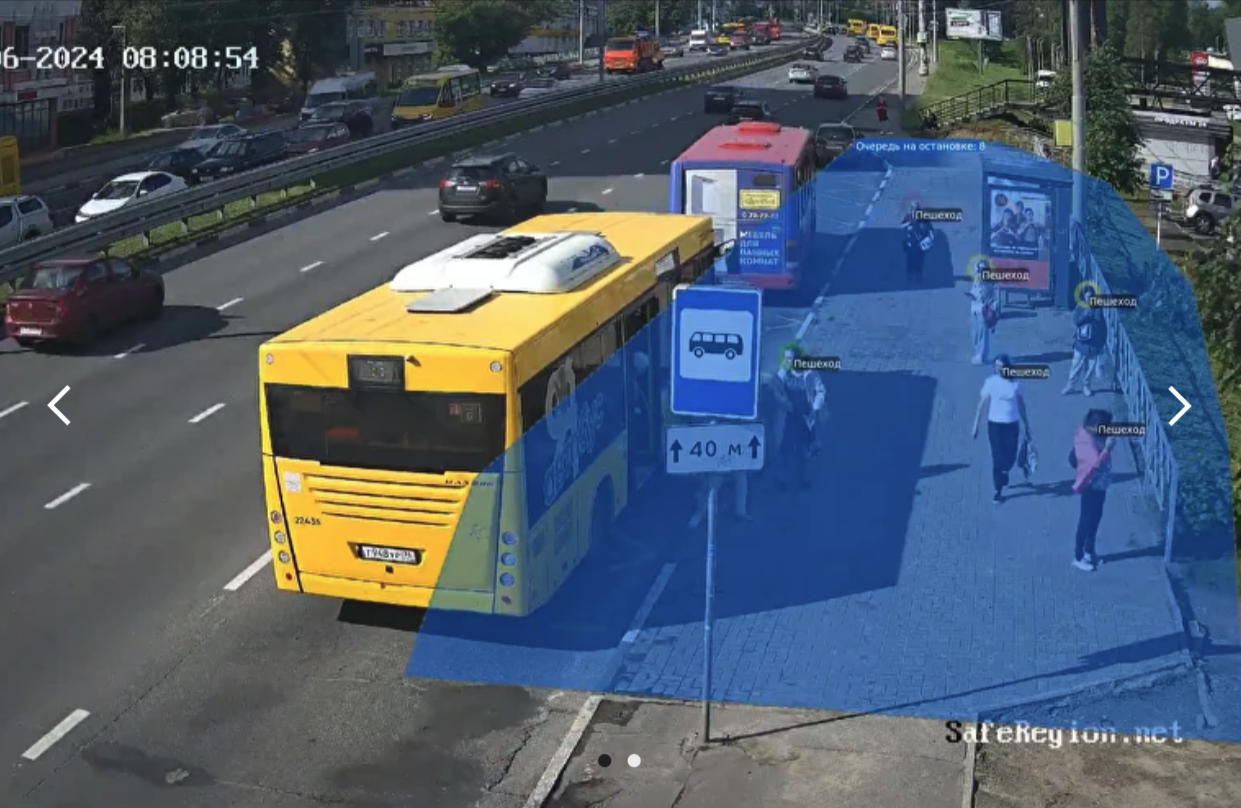
Currently, there is a shortage of staff in government bodies overseeing public transport, making it difficult to conduct monitoring internally. Recognizing the importance of monitoring, TrafficData LLC has developed software that allows automated monitoring of service quality parameters using video analytics from surveillance cameras.
The essence of this software lies in a comprehensive approach to collecting data on the functioning of the public transport system (both internal and external monitoring). This approach enables the creation of a correspondence matrix using transport services data and helps identify problem areas both within transport infrastructure and across the route network.
Parameters for internal monitoring inside vehicles:
Parameters for external monitoring (smart stops):
The software “Monitoring of Public Transport Service Quality Parameters from External Infrastructure” allows both real-time calculation of these parameters and post-processing of video data obtained from stop complexes.
Each year, city administrations and metropolitan authorities set the goal of improving the quality of public transport services. According to the Social Standard for Public Transport Services for Passenger and Baggage Transport by Road and Urban Electric Ground Transport (Order of the Ministry of Transport of the Russian Federation dated 31.01.2017 No. НА-19-р), quality indicators for public transport services and their normative values are established for municipal, intermunicipal, adjacent, interregional, and international regular routes.
The quality of public transport services is an integrated assessment of the level of service for passenger and baggage transportation by road and ground electric transport along regular routes. It is expressed through a combination of characteristics such as reliability, accessibility, and comfort.
Although the social standard provides quality indicators and calculation formulas, in practice it is often impossible to capture the exact quantitative values of these indicators.
To improve the quality of public transport services, accurate data on the current state of the transport system is essential. Based on a comprehensive assessment of these data, it becomes possible to develop measures to enhance transport services, including optimizing route networks and adjusting public transport timetables.
Service quality parameters must be monitored at least four times a year, continuously over the span of one week. This frequency accounts for seasonal variations and weekday–weekend differences. Such regular monitoring enables an objective evaluation of measures implemented to improve service quality.
Currently, there is a shortage of staff in government bodies overseeing public transport, making it difficult to conduct monitoring internally. Recognizing the importance of monitoring, TrafficData LLC has developed software that allows automated monitoring of service quality parameters using video analytics from surveillance cameras.
The essence of this software lies in a comprehensive approach to collecting data on the functioning of the public transport system (both internal and external monitoring). This approach enables the creation of a correspondence matrix using transport services data and helps identify problem areas both within transport infrastructure and across the route network.
- Internal monitoring: evaluation of service quality inside the vehicle.
- External monitoring: evaluation at bus stops (“smart stops”).
Parameters for internal monitoring inside vehicles:
- compliance with capacity standards (persons per sq. m);
- average speed across segments of the street-road network;
- passenger flow on the route (detailed by stops).
Parameters for external monitoring (smart stops):
- average waiting time at the stop;
- headway intervals;
- schedule adherence;
- detection of unauthorized (“grey”) operators;
- route number / garage number / license plate;
- arrival and departure times of vehicles;
- passenger accumulation at the stop;
- passenger boarding and alighting (with route details).
The software “Monitoring of Public Transport Service Quality Parameters from External Infrastructure” allows both real-time calculation of these parameters and post-processing of video data obtained from stop complexes.